| |
|
The Istro-Romanian Dialect Today (1998)
by Richard Sârbu
The Istro-Romanian dialect, one of the three South-Danubian Romanian
dialects, split off later from the trunk of Common Romanian, about 700
years ago. Today it is spoken by a limited number of people in two places
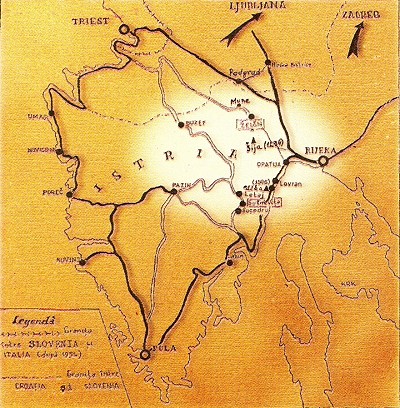
in the Istria peninsula, in Croatia - Jeiăn (Žejane), located
north-west of the town of Rijeka and of Mount Učka (Monte Maggiore), in
the region called Čičarija [Ciceria], and at Susnievita
(Susnjevica), south of Učka, as well as in a number of poorly populated
hamlets near Sušnjevica, along the valley of the Raša [Arsa] river (Val
D'Arsa).
The successors of the mediaeval Balkan Vlacks
[aka Vlahs], who had settled in these
regions as early as the 16th century, the descendants of the
Western Romanians, as Sextil Puscariu called them in his Studii
istroromâne (Istro-Romanian Studies), are today known in the area as
Rumeri, Cici, Ciribiri or Vlacks and total, according to more recent
information, under one thousand speakers [in Istria].
In spite of strong and persistent influences coming for centuries from
the Croatian, Slovenian and Italian languages, Istro-Romanian,
particularly the variant spoken in Jeiăn, has relatively well
preserved its basic structures in phonetics and morpho-syntax.
Istro-Romanian is among the few cases in which an idiom, spoken in an
alloglot milieu by a small number of people who did not, for centuries,
have - and do not have today either - any kind of cultural institutions of
their own, which could facilitate its preservation as a means of
interhuman communication, has lasted to our days. Due to historical
circumstances, almost always unpropitious, Istro-Romanians had neither
permanent schools, nor a church speaking their language, nor notable
cultural and literary traditions, as Macedo-Romanians did. For all this,
they have persisted as a "linguistic island".
As compared to the idiom spoken by the southern Istro-Romanians who
inhabit several small villages and hamlets south of mount Učka (Croatia),
and speak a language subject to constant changes, the idiom spoken by the
inhabitants of Žejane (Ž) has preserved to a higher degree the archaic
structures and elements inherited from proto- Romanian.
Sušnjevica (S), the place where most of the southern Istro-Romanian
speakers live, is situated along an important road (Pazin - Paz -Labin),
where, in the past, people used to speak Italian (Istro-Venetian) a lot,
and now they speak Croatian. On the other hand, in Zejane, which used to
belong, in the past, to the Slovenian administration in Podgrad (Ottanova
sul Carso) and to the Slovenian linguistic territory, having been
geographically more isolated until the third decade of our century and
less subject to Italian influences, old Istro-Romanian elements have been
better preserved.
The Istro-Romanians of Zejane have lived compactly to our days (102
houses, about 400 speakers - in 1982), being more isolated from the
massive influence of Croatian (i.e., the literary variant of the Ceacavian
[cakavian or chakavian?] dialect), and offering us, through their language, a pattern of the
Romance idiom (of the Romanian type) that has long opposed, especially
phonologically and morpho-syntactically, a powerful alloglot influence
(Croatian, Slovenian, Italian).
The number of Istro-Romanians seems to differ, in the view of one or
another, in various statistics published along the years, oscillating
between 525 (in 1850, Fr. Miklosich), 674 (in 1913, Schuck), apud Sextil
Puscariu, in collaboration with M. Bartoli, A. Belulovici and A. Byhan,
Studii istroromâne, II, Bucareşti, 1926, p. 42 - 43; 450 -
500 (in 1959-1963); cf. August Kovačec, Descrierea istroromânei
actuale, Bucuresti, 1971, p. 23; and 500 (in 1964); cf. Radu Flora,
Slovenačke leksičke posudjenice u istrorumunskom, "Linguistica". XII,
Ljubljana, 1971, p. 68. We should notice that, while the number of the
southern Istro-Romanians descreased rather rapidly according to the
statistics we know (from 2428 in 1850, after Fr. Miklosich, to 800 - 1000
in 1959 ~ 1963, after A. Kovačec), in Žejane, the number of the
Istro-Romanians did not decrease so dramatically in time.
The restrictive use of Istro-Romanian, especially in the last five
decades (since it is hardly an instrument of communication, especially for
the young commuters employed in the factories of Rijeka, Opatija and the
neighbourhood, or for those who, through mixed marriages, moved to other
towns or villages) is a process in full development even nowadays.
Though bilingual, both old and young Istro-Romanians have a
well-outlined linguistic awareness, being able to prove in fact that to speak " a cuvintå po nåšu, po jeiånski" means something
totally different from to speak "a cuvintå po hârv áţki."
The data offered by our investigations made in Žejane and Sušnjevica
(in 1982, 1992, 1994, 1995 and 1996), by which we checked, in the light of
linguistic and statistical typology, on the functionality of some
morpho-syntactical basic structures of the idiom spoken in Žejane, has
confirmed that the pressure exerted today by Croatian goes through all the
levels of Istro-Romanian, the morpho-syntactical one included. But this
influence manifests itself in different ways, being reflected by numerous
borrowings, and also by Istro-Romanian innovations, following some
Croatian pattern, and still remaining acquisitions of this idiom, as
alloglot elements, adapted to the Istro-Romanian linguistic system. By no
means does this influence appear under the form of massive dislocations
and disintegrations of whole compartments of the system, through the
replacement of the native linguistic structures by foreign ones; in some
rare cases, though, this may happen, especially at the discoursive level
of speech, when the bilingual Istro-Romanian, for various reasons,
occasionally passes unexpectedly from one code to another, alternating
the linguistic structures:
"...Ke ş-iča-n vârh de selişte sus ... av ståra ţårcva, ståra
beserica, betâda beserica ... e şi d-atunče pac a facut..." (Sancovit" Mate, aged 78,
Žejane - Ž).
One could see here the concurrence of the parallels in Croatian and
Istro-Romanian, the graded transition from the Croatian syntagm to the
Istro-Romanian one.
The "mixed" character of Istro-Romanian and the bilingualism of the
Istro-Romanians have drawn the attention of well- known Romanian and
foreign linguists since the 19th century. Several reasons have been given
either to support the theory according to which the dialect under
discussion is gradually losing its consistency until it disappears
together with its last speakers, or to support the theory regarding the
rapid disintegration of Istro-Romanian, through the process of mixing,
under the pressure of the contact languages, with cultural and economic
(and administrative) prestige, lately under the pressure of Croatian, "the second mother tongue of Istro-Romanians", as A. Kovačec
(op.
cit., p. 230).
See in this
respect S. Puşcariu, Studii
istroromâne, III, Bucureşti, 1929. Look for references to the latest
works about Istro-Romanian in Petru Neiescu, Din fonologia dialectului
istroromân, in "Studii şi cercetări Lingvistice", XXXI (1980), nr.
2, p. 137 - 148; E. Pctrovici, Rcziştenta sistemului fonologic la o
puternică influenţa străina, "Cercetări do lingvistică", IX (1964),
nr.l, p. 35 - 39; see also A. Kovačec. op. cit., p. 34; 1. Coteanu,
Cum dispare o limbă (istroromâna), Bucureşti, 1957; Elena
Scărlatoiu, Istroromânii şi istroromâna. Reliaţii lingvistice cu slavii
de sud, Bucureşti, 1998, p. 72 - 75.
Despite the multisecular pressure exerted upon this idiom by Croatian,
Slovenian and Italian (Istrian Venetian), Istro-Romanian is actively used
only in Žejane (3 kilometers away, in Mune, it has not been spoken for a
long time); it is used by the villagers, in the family, in the street, on
different everyday or solemn occasions, on the occasion of traditional
folk holidays. Thus, we cannot say that contemporary Istro-Romanian has an
exclusively "family" status (because it does not!). On the contrary, in
Žejane, Istro-Romanian is the language of the village, as A.
Kovačec states, in the quoted work (p. 195).
Like any other idiom functioning in an unrelated linguistic medium, the
system of Istro-Romanian displays both areas, more resistant to the
alloglot influence, in which the elements of the so-called "prestige"
languages penetrate with more difficulty, and in which the persistency of
the Istro-Romanian elements is greater (the phonological, morphological
and morpho-syntactical systems), and areas in which the ailoglot elements
literally invade entire compartments (the vocabulary, but also the
sentence word-order suprasegmental elements).
The persistency of the old Latin elements in Istro-Romanian at the
phonological level, fully and repeatedly exemplified, is proved again in
more recent investigations (see supra!). The specific phonetic
features of this idiom, revealed by Sextil Puşcariu in his "Studii
...", by his predecessors and followers, are still thoroughly fixed in the
speech of the majority of the Žejane inhabitants, interviewed by us. More
or less important modifications can be observed especially in the field of
syntactic phonetics.
From among the morpho-syntactical elements of the idiom that contribute
to the persistency of Istro-Romanian, to its preservation as a "linguistic
island" in a medium strongly influenced by Croatian, we notice first of
all, the well-preserved forms in the paradigm of the noun, the pronoun and
the verb.
The analytical forms of the nouns marked in the Genitive-Dative by lu (masc.) and le (fem.), e.g., lu bovu, le
mul'åre are widely spread. Synthetic forms can be found only in
poetry, sayings and proverbs, where these forms became fixed long ago.
E.g., Oi I'epure nu jucå / Ke te båte måia tå / Cu spinuşu plugului...
(Mila Sancović, lu Tonić, aged 47, Ž).
One could observe the good preservation of the possessive and
demonstrative adjectives and pronouns, of old forms inherited from proto-Romanian, which had a specific evolution in Istro-Romanian, but which
became stable depending on person, number of possessors and possessed
objects, case, gender, exactly like in Daco-Romanian. At the same time,
one could note the generalization of the forms without emphatic a
(čela). For example, here is a text about photos:
"Cåsta-i fil'a lu fråtele. Česta. Česta-i fil'u lu a lui.(...)
Čåsta-i cu
lu a melvę fråte fil'u. Česta-i fil'u a lui. Česta-i unucu lu a lui.
Česta-i
spomenicu a melvę fil' ce ie-n Australie murit"
(Catarina Sancović,
aged 81, Ž).
As far as the Istro-Romanian verb is concerned, we can notice that the
old inflection is well-preserved, generally, but that among the tenses of
the indicative, the most frequently used are the present, the future and
the perfect. The forms of the restrictive conditional occur both in the
speech of the adults and in that of the younger generation:
"N-åm avzit se rę ieşi (ča cårte) ke reş cumparå
"
(Mate Sancović, aged 78, Ž}. "Ręş io an cetate ramâre"
(Sergio Turcovic, aged 27, Z). "Se ręţ ier veri ma
reţ ajutå cåsa pobeli" (Emil Marmelić, lu Mayåta, aged 42,
Ž).The conjunctive has forms identical with the indicative (only the verb
a fi "to be") - has distinct forms for the conjunctive, but even
these forms are frequently replaced by indicative ones, following, in
use, the Croatian pattern with the conjunction neka (more rarely -
se):
"Cui i-e fome neca-ntreba": "Verit merindå!; Acmo
morem noi doi bę. (Maria Sancović, aged 50, Ž); "Fil'i
meg ân
četåte jivi" (Ielca Doričic, aged 66, Ž). "Mire piåze
pemintu lucrå " (Frane Belulović, aged 61 [1], S).Well-preserved are also the construction with cardinal numerals from 1
to 6, and those with ordinal numerals of Romance origin. Even the numerals
from 7 to 19, the tens and the hundreds, which are lexical borrowings from
Croatian (unlike in Daco-Romanian, where they are Romanian formations),
are used in speech, following the old Romanian pattern, for example:"Mul'åra lucra-n şula påtru ure na dan. le moręit lucrå sto
osemdeset şi do ure... Io voi avę u deţembru sesnaistog pedeset si
cine (Anton Doričić, aged 55, Ž). "Na dvanaist de detembre voi
av.% sesdeset si ur ań
"
(Frane Belulović, aged 61 [1], S).To illustrate the persistency of the archaic elements and the
innovations which do not occur under alloglot influence, but as a result
of internal factors, we shall give, in what follows, two texts in which
the old Latin elements and the structures of the Romanian type are
preponderent:"Pure, pure-n foc ke se va stinje.
Čeşt"'a toţ şedu ocol' de spuryet, ma nu va
ničur ânutru pure, D-atunče cuvintu ke I'-e råče"
(Drago
Sancović, Bârco, aged 48, Ž);
"Uri rumuń verit oånča fir cu cål'i. Pac
åu ujęit ziče: Bura domaręţa! şi Bura sęra!
Ânca d-atunče ştivu, io åm vezut, morę-i deset let. Pac ştiu şi pac åm
ântrebavęit cum č-åv zis. De şterne
åv zis
fântâna.
Noi şternę zicem. Fantara kemåm
colę
afåra. Betāri åu zis fântâra...
Čå če-i afåra facuta din
selişte, č--åv betāri facut, čå se kiåma fântâra po nåşu"
(Måtina lu Matiću, aged 78, Ž).
On the other hand, as we have already pointed out, Istro-Romanian
changes its the compartments less resistant to the alloglot pressure. The
areas subject to the massive Croatian influence have gradually lost their
consistency, their specific character; certain subsystems or structures of
the idiom have developed under the influence of a foreign pattern (e.g.,
aspectual oppositions, predicative constructions with neuter adjectives
and with adverbs in -o, the numeral from 11 to 19, the adverb, the
word order with its multiple morphological implications, such as the
dropping of the articulated forms of preposed adjectives, the dislocating
of the auxiliary from the verb, elliptical constructions etc.).
The vocabulary, especially, is subject to changes, and this has direct
effects on morpho-syntax.
Thus, as I. Coteanu points out, in the Istro-Romanian basic word stock,
from the point of view of their origin, over 30-35 per cent of the terms
are Croatian or Slovenian; the figure R. Flora gives, on the basis of a
study made on a shorter text is 50 per cent. A. Kovačec, on the basis of
his statistical glossary of 85,000 Istro-Romanian words, considers that
Latin terms belong to the basic word stock, and Slavic (Croatian) words
belong to the rest of the vocabulary; he states that Slavic verbs are
almost three times more numerous than Romance verbs, but, in contexts, the
situation is reversed: Slavic verbs have a lower frequency, as compared to
the old Romanian verbs. [editor's [2]
Statistically speaking, in a corpus of 3000 words, the terms of
Croatian or Slovenian origin, are almost 1/3 out of the total vocabulary,
and words of Latin origin represent 2/3. Out of the total 325 complex and
compound sentences in the recordet text, the autonomous morpho-syntactical
structures of the Slavic type represent 9,5 per cent, those of the
Romanian type represent 27,5 per cent and the hybrid structures represent
63 per cent (cf. Richard Sarbu, Present-day tendencies in the
morpho-syntax of Istro-Romanian dialect, in "Linguistica", XXXI,
Ljubljana, 1991, p. 153).
As a result of the Istro-Romanian's pluri-lingualism, in morpo-syntax
innovations are more numerous than archaisms.Thus, having taken over the
Croatian aspectual oppositions, the verb, which is the part of speech with
the greatest functional yield in a complex sentence, has both hybrid
structures with Istro-Romanian functional root and indicator (suffix) and
with Croatian aspectual indicator (prefix), and with complete Slavic
structures, in which only the infinitive indicator is of the Romanian
type: Cf. leg å-razlegå,
plånje - zaplânje, durmi - zadurmi, učide — zaučide, furå —pofurå,
etc, respectively,
copęi - scopęi, reji ~ obreji, leti - doleti, etc.
The transfer of Slavic aspectual indicators, together with their
functions, to Istro-Romanian shows the ease with which present-day
speakers can switch from one language to the other, the general and active
character of the bilingualism of Istro-Romanians.
As far as the two directions followed by the Istro-Romanian verb are
concerned (in the marking of predicativity with aspectual forms), we can
notice a tendency to avoid the hybrid suppletive opposition and fully
accept the Croatian aspectual oppositions (especially, in the speech of
the young people, who use, e.g., cr. predi - spredi instead of
Istro-Romanian torče -potorče).
The cases in which the aspectual opposition is not expressed
morphematically, and is understood only contextually are also frequent:
vegl' å, acaţå,
tråje, muri, avzi.
Another
area deeply influenced by the Croatian language is word order. Word order
in Croatian is relatively fixed, because syntactical functions are
generally expressed morphematically, and Istro-Romanian often uses this
free word order even where the syntactical functions should be expressed
by word order. One of the effects of this free word order is the
dislocation of the auxiliary from the verb, e.g.:
"Ân cârca cu brenta
åm
åpa purtåt,
cu cârcoåta"
(Mila
Sancović, aged 47, Ž). "Pac s-åv cu tractoru učis"
(Catarina
Sancović, aged 81, Ž). One should also mention the frequent use of
elliptical forms by Istro-Romanians and by Croatians, e.g.: "Cum
åm io cuvintåt, åv şi ie"; "Åmş vişe (vręme durmit) "
(M. Sancović, aged
78, Ž).The use of the neuter forms of adjectives and adverbs, following the
Croatian pattern in -o, in predicative construction is generalized
: "Idco burof", but also, more rarely: "Bur a fast!" (Draga
Turcović, aged 66, Ž). Cf. also: Ce-i de novo? Åi tāmno. Âifino!
(idem).Another field in which Croatian forms have imposed themselves is the
vocative,especially in the case of borrowings:
Cume! Sincol F ęto,
fęto,
fętiţe!
Concluding, we must say that the pressure exerted by one
linguistic system upon another, with which it is in contact, manifests
itself more or less intensely, depending on the resistant or fragile
character of the areas where the pressure is exerted:
- either as a transfer of entire structures and
elements, in their original form, unadapted to the system of the contact
language;
- or as a transfer of partial structures and elements.
In this latter case, we may distinguish between different types of
linguistic translation loans (full and half -), and hybrid morphological
and morpho-syntactical structures, which, in turn, may be of two types,
depending on the directions along which the intersystemic pressure takes
place and on the character of the systemic forms which impose themselves
in present-day innovations, depending on the pattern (internal or
external) followed by these hybrid constructions.
Editor's Notes (not in the original):
-
Unless the writer has shown the wrong age or the quotation
is of an older date, this is not the same person as the Frane Belulović
who was born in 1921 and would have been 67 in 1998 when this text was
published.
- The bolding in this text is not in the original text.
Source:
- Text and image - Richard Sârbu & Vasile Frăţilă, Dialectul
Istroromân, Editura Amarcord (Timişoara, 1998), p. 35-42.
|
Main
Menu
Created: Friday, November 03, 2000; Last Updated:
Tuesday, March 01, 2022
Copyright © 1998
IstriaNet.org, USA
|
|